European researchers develop energy-efficient machine vision inspired by human eyesight and the brain
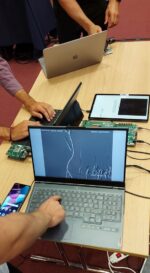
Drawing inspiration from human eyesight, a European research project led by VTT has developed machine vision mimicking the cooperation of the eye and nervous system, implemented as edge-computing circuits. Edge computing means processing data where it is generated and where the results of computing are needed. This enables, for instance, intelligent robots and drones that can operate independently in a rescue mission after an earthquake without constant network connections or bulky batteries. Launched in 2021, the MISEL project (Multispectral Intelligent Vision System with Embedded Low-Power Neural Computing) is now nearing completion. Coordinated by VTT Technical Research Centre of Finland, the project has combined neuromorphic computing—which mimics the way the brain processes information—with semiconductor technologies. “Our goal is to build truly smart devices that can make observations and decisions on their own, without sending data to supercomputers or the cloud. Neuromorphic computing can be hundreds or even thousands of times more energy-efficient than conventional digital processing,” explains Jacek Flak, Research Team Leader at VTT, who coordinates the project. The MISEL project received nearly EUR 5 million in funding from the EU’s Horizon 2020 programme. Alongside VTT, partners include the universities of Łódź, Lund, Santiago de Compostela, and Wuppertal, the Fraunhofer Institute, France’s LNE national research institute, and the companies Kovilta Oy (Finland) and AMO GmbH (Germany). The consortium unites expertise across disciplines, including materials science, electronics, and algorithm design. Smarter mobile devices without constant connectivity Artificial intelligence typically requires either good network connectivity to cloud services or substantial local computing power. However, the MISEL project brings intelligence to the edge—directly into the devices themselves. This approach allows battery-powered systems to process and interpret sensory data quickly and with low power consumption, while also reducing cybersecurity privacy risks. “Imagine a drone searching for survivors after an earthquake through smoke, dust, and debris. It needs to interpret […]