Quantum-inspired wireless technology could tackle 6G’s biggest challenges
Researchers at Monash University and The University of Melbourne have developed a quantum-inspired approach to optical wireless communication that promises to make 6G networks faster, more reliable and energy-efficient.
As the world moves toward 6G, devices and networks will need to handle more data, faster, and in smaller spaces than ever before.
The breakthrough addresses a key hurdle for next-generation wireless networks – enabling seamless connections not just between phones and laptops, but also among the chiplets inside computers, smart devices in offices and data centres.
Professor Malin Premaratne, a pioneer in quantum device technologies from the Department of Electrical and Computer Systems Engineering at Monash University, is one of the researchers responsible for a method that enables reliable, high-speed connections in crowded spaces, bringing wireless performance closer to “fiber-like” speeds in indoor networks.
Professor Premaratne noted that in these environments, conventional wireless signals face serious limitations.
“Interference can slow connections, reliability drops in crowded or complex settings, energy consumption and heat restrict performance, and scaling networks requires complex wiring,” Professor Premaratne said.
“It’s about making the next generation of devices and networks actually deliver on the promise of 6G – speed, reliability and energy efficiency – so people notice the difference in their everyday lives. This is a crucial step toward making 6G networks practical for everyday devices and future computing systems.”
This research could enable faster and more reliable 6G wireless in homes, offices and public spaces, while powering smarter devices that run cooler and use less energy. 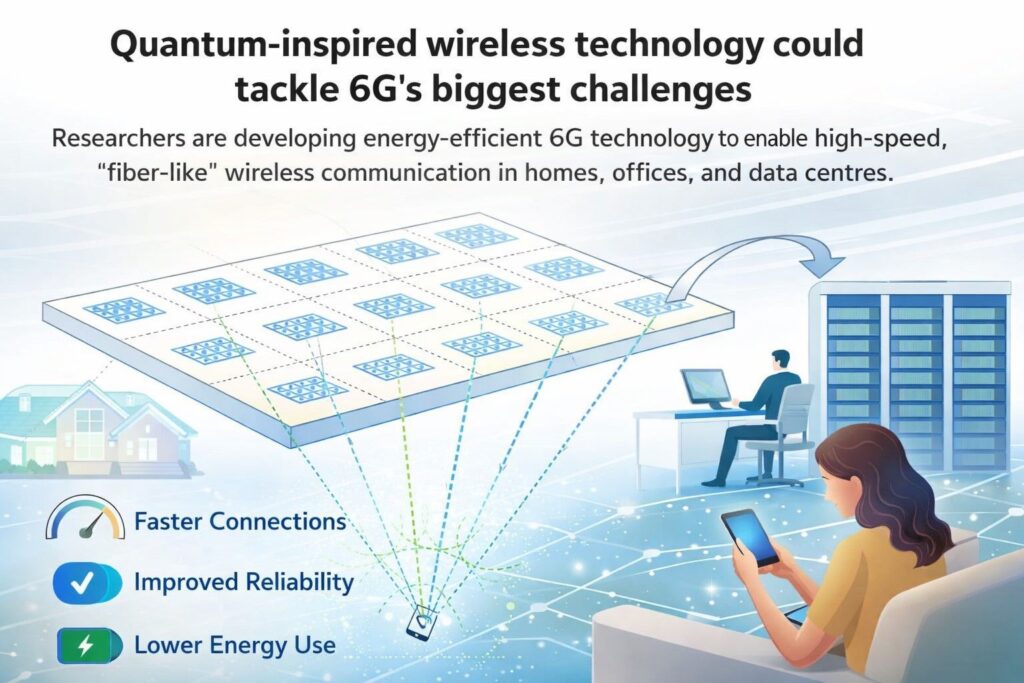
Professor Thas Nirmalathas, a pioneer in optical wireless communications at The University of Melbourne, said the team’s innovation uses modular optical phased arrays inspired by principles from quantum physics.
“The research combines quantum-inspired design with optical wireless innovation to tackle key challenges in the design of next-generation ultra broadband wireless systems,” Professor Nirmalathas said.
“Networks built this way can also adapt and grow with future technology demands. Building networks from flexible, reconfigurable blocks allows wireless systems to focus signals precisely where they are needed, reduce interference through polarisation control, improve energy efficiency, and scale easily without redesigning entire networks.”
This research collaboration was supported through an ARC Discovery program.
“In quantum devices, coherence and collective effects like superradiance allow many small sources to behave like one powerful, directed emitter. Our quantum-inspired optical phased-array approach brings that ‘many-as-one’ principle to optical wireless, enabling scalable beamforming – and more reliable, energy-efficient links – as networks get denser toward 6G,” Professor Premaratne said.
Dr Kosala Herat, now a Marie Skłodowska-Curie Postdoctoral Fellow at Lund University, Sweden, and Sharadhi Gunathilake at Monash, made significant contributions to the research.


